Your DNA meets
the air you breathe.
Updated daily.
The only product that connects your DNA to the air outside your window, helping you understand how today's air quality and pollen levels may affect your health differently than others.
—
Plus the cost of DNA test or raw data upload.
Environmental Phenotypes
Six Environmental Phenotypes. One of Them Is Yours.
Genetics describe how you're built. Environment decides what that means in practice. We sort the intersection into six phenotypes. You'll find yourself in one.

Mold Reactor
You can smell the basement from upstairs

Air Quality Sensitive
Your lungs read the AQI before you do

Methylation
Allergic to the modern world's exhaust

Seasonal Allergen
April is the cruelest month

Oxidative Defense
The friend who notices first

Resilient Baseline
You travel well. You sleep on planes.
PM2.5
Good
Ozone
Moderate
Tree pollen
Moderate
Mold
Low
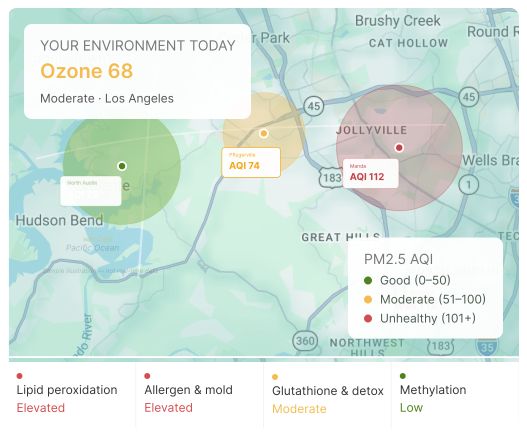
Your genetics meet your environment.
Most people think about food when they think about health. We built Gene Food Environment to help you start thinking about air quality, pollen, and daily environmental conditions as part of that picture too.
Live air quality, daily
PM2.5, ozone, NO₂, SO₂, CO, and PM10 from the EPA AirNow network — updated daily for your zip code.
Pollen, by zip code
Tree, grass, and weed pollen counts updated daily for your exact location.
EPA toxic release facilities
Industrial facilities near you releasing fugitive air emissions, sourced from the EPA Toxic Release Inventory.
Seven pathway dashboards
Lipid peroxidation, allergen & mold, glutathione, antioxidant enzymes, methylation, and vitamin C & E — 59 GWAS-validated markers.
Built for all four seasons
The product is designed to be most informative across a full annual cycle of environmental change.
Spring
Tree pollen peak
Summer
Ozone & heat
Fall
Wildfire smoke
Winter
Particulate matter
Oxidative stress scoring
Your genetic capacity to neutralize environmental oxidants, scored across key pathways.
The founding product of Personal Environmental Genomics
I've worked in health and wellness for nearly a decade and tried everything. The most surprising thing I've come to understand is that where you live may matter as much as what you eat. I built Gene Food Environment to give people a way to access information about both — their genetics and their daily environment — in one place, so they can start asking better questions.

John O'Connor
Founder, Gene Food

Science standard
GWAS-first. Every marker identified through genome-wide association studies. Study sizes: 6,000–52,000 participants per finding.

What we display
Published associations only. Your genotype alongside the research finding, with source citation. No predictions. No diagnoses.

Environmental data
Extensive live air quality and pollen readings paired with TRI facility data for industrial sites near you. Informational reports only — you draw the conclusions.
Gene Food Environment
 Your DNA + today’s air quality
- Genetic environmental sensitivity profile
- Air, pollen & TRI data for your address
- Compare locations
—
per month · cancel anytime
Already have Gene Food, 23andMe, or AncestryDNA raw data?
Upload your file and start today — no new kit needed.
Gene Food Environment is an informational and educational product. It does not diagnose, treat, cure, or prevent any medical condition. Genetic associations displayed reflect population-level research findings from published GWAS studies and do not predict individual health outcomes. Environmental data is provided for general contextual reference only and is not a substitute for official public health guidance. Consult a qualified healthcare provider before making changes based on genetic or environmental information.