Field Guide № 04 — Specimen Habitats
What is your ideal
Zoo exhibit?
If aliens captured you tomorrow and took you as a specimen for an intergalactic zoo, what habitat would they build for you?
The keepers would need your spec sheet — the genetic blueprint, read while you were sedated. From it they'd reconstruct the air you evolved to breathe, the pollens that arrest you, the particulars you live on without noticing.
Six environmental phenotypes. One of them is yours.
—
Plus the cost of DNA test or raw data upload.
Sixty seconds, before the tour.
A short film on why your environmental phenotype might be the most actionable piece of your biology — and how live air, pollen, and EPA data turn a genetic profile into a daily signal.
- Your environmental phenotype
- Live air quality
- Daily pollen
- EPA toxic-release facilities
- 59 GWAS-validated markers
- Your Gene Food diet type
Inside The Report
Your environmental report connects your genetics to the world around you, combining GWAS-validated markers with hyper-local environmental data to deliver insights you can actually act on.
See the instrument ↓Chapter I
The Six Phenotypes
001 — 006
Every human falls into one of six.
Your genome encodes six environmental signatures — patterns in how your body responds to the air, the allergens, and the chemistry of the world around you. They are quiet, lifelong, and mostly invisible until something in the environment changes. The aliens, having sequenced you, would build accordingly. Below: what each enclosure looks like, and which one is probably yours.
Exhibit № 001 / Mold Reactor
Mold Reactor
High Desert · Low Humidity
Your immune system runs an unusually attentive surveillance program on fungal spores. Damp basements register. Old hotel rooms register. So does the back of certain HVAC systems. For most people this is background noise; for you it's a signal.
Ideal city
Phoenix, Albuquerque, Denver. High altitude, low humidity, sun on stucco. Anywhere a leaf rots slowly.
The alibis
A high-desert enclosure. Sandstone, dry wind, a single juniper. Humidity capped at 30%. The keepers raise the air handlers and check the filters daily. There is no carpet in your habitat. There has never been carpet.
Markers
Alternaria response · mold sensitivity loci

Exhibit № 002 / Air Quality Sensitive
Air Quality Sensitive
Coastal Cliff · Onshore Wind
Your lungs and blood vessels are unusually exposed to the chemistry of urban air — fine particulates, ozone, traffic-adjacent oxidation. Your genome governing lipid peroxidation runs at a thinner margin than average. You feel it on bad-AQI days even when you can't name what's wrong.
Ideal city
Reykjavík, Wellington, coastal Maine. Air that has a temperature but not a flavor.
The alibis
A coastal cliff enclosure on the leeward side of the dunes. Salt air, constant breeze, no combustion permitted within a thousand meters. The keepers post the particulate count next to the feeding schedule. Visitors are asked not to idle their cars.
Markers
STX10 · lipid peroxidation loci

Exhibit № 003 / Methylation
Methylation
Cedar Interior · Predictable Seasons
Methylation is the body's quiet bureaucracy — the daily filing of one-carbon units that keeps detox, neurotransmitters, and DNA repair running. Your variants make this work harder than average. You need the cofactors. You don't do well with chemical clutter: synthetic fragrance, off-gassing furniture, the smell of a new car.
Ideal city
Kyoto, Copenhagen, small towns in Vermont. Wood, stone, linen, predictable seasons.
The alibis
An interior of untreated cedar and river stone. Linen bedding. A small garden of leafy greens and beets, because the keepers read the literature. The air smells like nothing in particular, which is the point.
Markers
Cedar methylation cluster · folate cycle loci

Exhibit № 004 / Seasonal Allergen
Seasonal Allergen
Glass Biosphere · HEPA-Filtered
For roughly six weeks each year your immune system declares war on a category of pollen the rest of your species barely notices. Tree pollen in April. Grass in June. Ragweed in September. Your genome encodes an unusually elegant overreaction.
Ideal city
San Francisco, Lisbon, Tel Aviv. Mediterranean climates with short, controlled allergen seasons. Or, in a pinch, a boat.
The alibis
A glass biosphere with HEPA-filtered intake and a strictly curated botanical roster — no birch, no oak, no ragweed. Olive trees and rosemary, which you tolerate.
Markers
Pollen sensitivity · IgE response loci
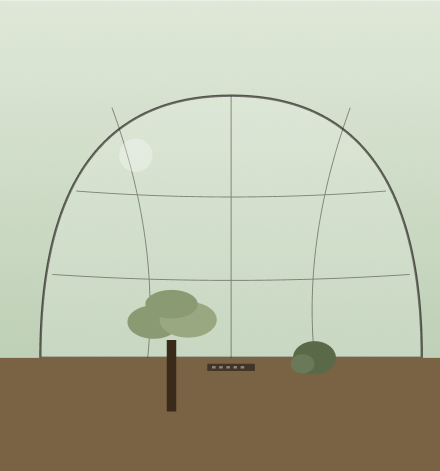
Exhibit № 005 / Oxidative Defense
Oxidative Defense
Temperate Forest · Filtered Light
Your antioxidant machinery — glutathione, the enzyme scavengers — runs lean. You neutralize environmental oxidants more slowly than most, so smoke, heat, and pollution take a little longer to clear. You are the friend who notices the wildfire haze first.
Ideal city
Portland, Vancouver, the Pacific Northwest. Cool, green, filtered light. Air that has been through a forest first.
The alibis
A temperate forest enclosure with filtered light and soft, even terrain. The keepers curate the canopy and keep the smoke out.
Markers
Glutathione pathway · antioxidant enzyme loci

Exhibit № 006 / Resilient Baseline
Resilient Baseline
Mixed Biome · Open Range
You are the keeper's easiest assignment, and faintly their disappointment. Your environmental genome registers no strong sensitivities — you travel well, you sleep on planes, bad air is an inconvenience rather than an event. The enclosure almost builds itself.
Ideal city
Almost anywhere. You adapt. The keepers stop worrying.
The alibis
A designed mixed enclosure — grass, oak, open range. Standard air handling. The placard is short, because there is not much to warn the visitors about.
Markers
Balanced environmental response

Chapter II
The Instrument
001 — 006
How the report actually reads.
The phenotype is the headline. Underneath it is a real instrument: live environmental data for your zip code, paired with your genetic markers across the pathways that matter. Updated daily. Sourced from EPA and peer-reviewed GWAS literature.
№ 001 / Air
Live air quality, daily
PM2.5, ozone, NO₂, SO₂, CO, and PM10 from the EPA AirNow network — updated daily for your zip code.
№ 002 / Pollen
Pollen, by zip code
Tree, grass, and weed pollen counts updated daily for your exact location.
№ 003 / Facilities
EPA toxic release facilities
Industrial facilities near you releasing fugitive air emissions, sourced from the EPA Toxic Release Inventory.
№ 004 / Pathways
Pathway dashboards
Lipid peroxidation, allergen & mold, glutathione, antioxidant enzymes, methylation, and vitamin C & E — 59 GWAS-validated markers.
№ 005 / Scoring
Oxidative stress scoring
Your genetic capacity to neutralize environmental oxidants, scored across key pathways.
№ 006 / Also included
Your Gene Food diet type
One of 20 proprietary diet types, built from how your body actually handles carbs, fats, histamine, and protein. The foundational Gene Food report, bundled in.
Field Guide № 04 — End of Life
Find out which one is yours.
Gene Food Environment reads 59 GWAS-validated markers from your DNA and pairs them with the live air, pollen, and particulate data outside your window. So you stop wondering whether the zoo got the habitat right.
Get started— · Cancel anytime · Add to any DNA test or raw data upload
Gene Food Environment is an informational and educational product. It does not diagnose, treat, cure, or prevent any medical condition. Genetic associations displayed reflect population-level research findings from published GWAS studies and do not predict individual health outcomes. Environmental data is provided for general contextual reference only and is not a substitute for official public health guidance. Consult a qualified healthcare provider before making changes based on genetic or environmental information.